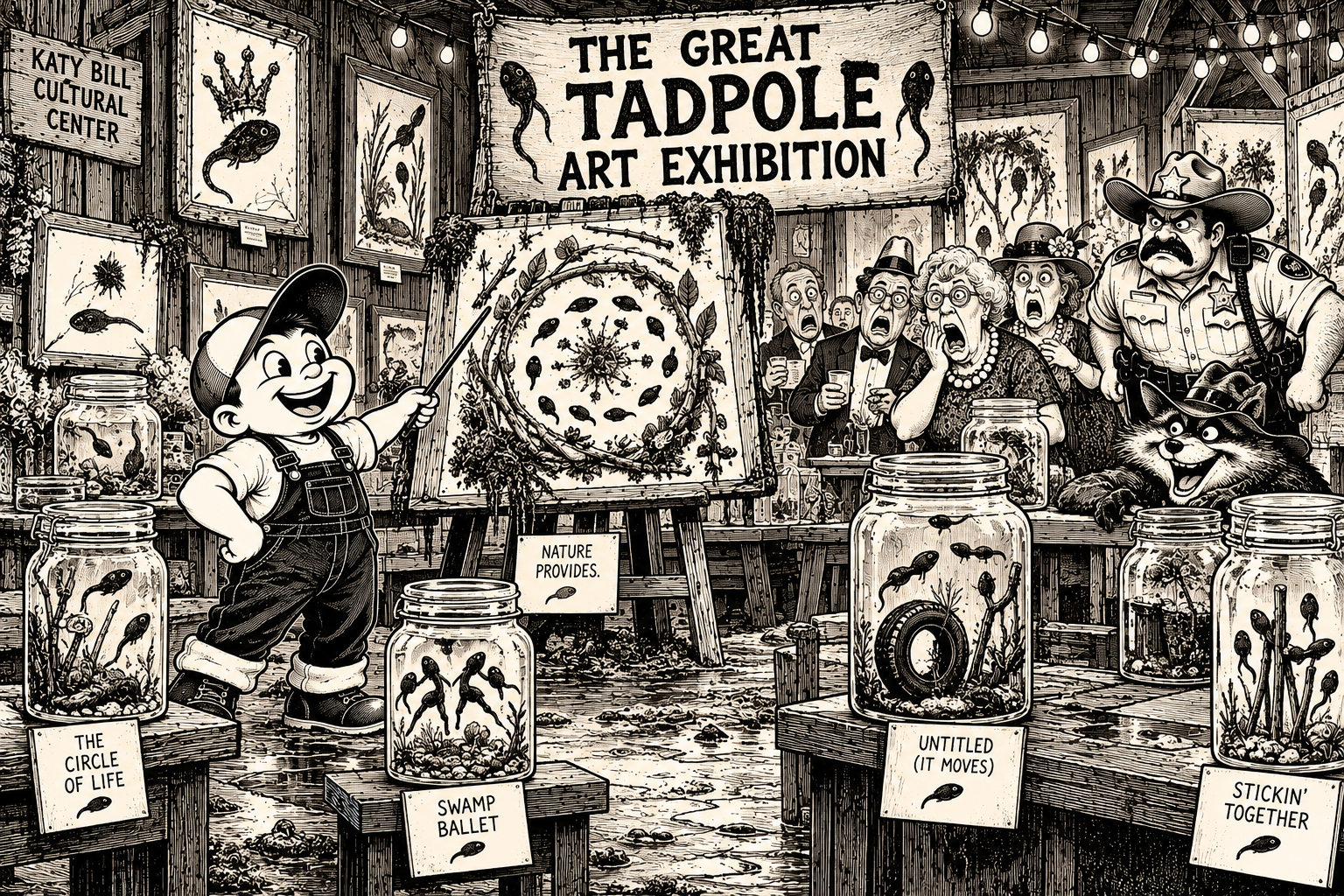
Tale #007 — The Great Tadpole Art Exhibition
As told by Betsy LeAnne Broussard
There are people in this world who can look at a muddy smear on a piece of plywood and see the human condition.
I ain’t one of them.
I look at a muddy smear on a piece of plywood and see a reason to get a rag.
But I don’t run the Katy Bill Arts Council, and I certainly don’t pretend to understand what makes something worth four hundred dollars.
Which is how I ended up attending an art exhibition where the featured painters were forty-seven tadpoles, the sheriff tried to arrest one of them, and a woman from Baton Rouge offered six hundred dollars for a piece of evidence.
The worst part?
The art was selling.
The Katy Bill Arts Council had been trying to make something of itself for years.
We had talented people in town. Miss Opal Guidry painted beautiful landscapes. Mr. Landry carved birds out of cypress. There was a retired schoolteacher named Bernice who could make a quilt so pretty you’d feel guilty sleeping under it.
But most folks around Katy Bill didn’t go out of their way to attend an art exhibition.
They’d go to a fish fry.
They’d go to a tractor pull.
They’d go watch two grown men argue over whose goat had the better personality.
But tell them somebody was displaying mixed-media interpretations of rural identity, and they’d suddenly remember they had a fence to fix.
So the arts council rented the old cotton gin for its first annual Fall Fine Arts Exhibition.
They put up lights.
Borrowed folding tables.
Hung white sheets over the rough walls.
And invited a visiting artist from Baton Rouge who specialized in abstract ink paintings.
Her name was Celeste Fontenot.
Her work involved pouring colored ink onto canvas, tilting it, and allowing gravity to determine the result.
Now, I ain’t saying she wasn’t talented.
I’m saying if I’d spilled blackberry syrup on a tablecloth and called it The Loneliness of Tuesday, nobody would’ve offered me nine hundred dollars.
But Celeste had a gallery in Baton Rouge, so apparently she knew something I didn’t.
The trouble started when Hoss saw her picture in the exhibition flyer.
He was at the Farm & Feed buying mineral blocks.
Frank had taped the flyer beside the cash register.
Hoss stood there looking at a photograph of Celeste’s painting.
It was purple and green with little black streaks running through it.
“Frank?”
“Yeah?”
“What’s that?”
“Art.”
Hoss leaned closer.
“What’s it made outta?”
“Ink, I reckon.”
“How’d she get them little squiggles?”
“Pour it around, I guess.”
Hoss stared.
Then he smiled.
“Well, hell. I got some fellers doin’ that.”
Frank looked up from the register.
“Doing what?”
“Art.”
“Who?”
“My tadpoles.”
Frank stopped.
“Your what?”
“Graf Feet T boys. Been makin’ pictures down by the drainage pond.”
Now, if you ain’t familiar with the Graf Feet T tadpoles, consider yourself fortunate.
They’re a collection of tiny amphibian delinquents who’ve taken a particular interest in Sheriff Bert Grant.
Biggun has been finding muddy spirals on his office paperwork for weeks.
Little tail marks on his filing cabinet.
Black smears on his windows.
Once, somebody left a dead mosquito in the center of his desk calendar.
Biggun blamed the tadpoles.
He had photographs.
He had dates.
He had a folder labeled AMPHIBIAN VANDALISM — ONGOING.
What he did not have was a suspect in custody.
Hoss, meanwhile, knew his tadpoles were making interesting marks.
He did not know they’d been terrorizing the sheriff.
And he certainly didn’t know those two facts were connected.
Frank pointed at the flyer.
“Well, the exhibition’s open to local artists.”
Hoss nodded.
“Reckon mine qualify.”
“Can they paint?”
“Sure can.”
“With brushes?”
Hoss thought about it.
“Mostly their butts.”
Frank went back to counting change.
Some men know when to stop asking questions.
Frank is one of them.
Hoss came into my Stop-N-Go that afternoon with three muddy feed sacks, a boot box lid, and a piece of plywood.
He laid them on my counter.
“Hey, Betsy.”
I looked down.
“Elbert, why’ve you brought me garbage?”
“Art.”
“That’s a feed sack.”
“Yes, ma’am.”
“With mud on it.”
“That’s the art part.”
I picked up the boot box lid.
There were seven black dots on it and a dead mosquito stuck near the corner.
“What’s this supposed to be?”
“Seven Thoughts About Corn.”
I stared at him.
“Where’s the corn?”
He looked at the lid.
Then back at me.
“That’s what they’re thinkin’ about.”
I put it down.
There are answers a woman can give to that.
None of them improve her day.
He showed me the plywood next.
It had a beautiful little spiral on it, if I’m being fair.
A thin, dark line curved inward, then broke into several muddy streaks.
“That one’s called A Frog’s Remorse.”
“What’s the frog sorry about?”
“Dunno.”
“Then why’d you call it that?”
“Looks sorry.”
I rubbed my forehead.
“Elbert, what’re you planning to do with these?”
“Enter ’em in the art show.”
I looked at him.
Then at the plywood.
Then at the mosquito.
“Have you talked to the arts council?”
“Not yet.”
“Do you know anything about exhibiting art?”
“No, ma’am.”
“Do you know anything about art at all?”
He smiled.
“Know it when I see it.”
I wanted to argue.
But I couldn’t honestly claim I understood Celeste Fontenot’s paintings any better than he did.
So I pointed him toward Miss Vivian Thibodeaux, who ran the arts council.
And I told him not to bring the tadpoles into my store.
That last part was important.
I’d just had the floors mopped.
Miss Vivian was a tall woman with silver hair, long earrings, and the kind of posture that made everybody else feel like they’d forgotten to stand up straight.
She believed in culture.
She believed in education.
And she believed Katy Bill deserved more than tractor pulls and church suppers.
I liked her.
I also knew she’d never met anything quite like Elbert Dale Hoss.
He arrived at the cotton gin Wednesday morning carrying his three masterpieces.
Miss Vivian studied them.
She tilted her head.
Stepped back.
Stepped forward.
Put on her glasses.
Took them off again.
“Interesting.”
Hoss beamed.
“Thank you, ma’am.”
She pointed at the plywood.
“The spiral is especially compelling.”
“Yes, ma’am.”
“What medium does the artist use?”
“Mostly water.”
“Water?”
“And mud.”
She nodded thoughtfully.
“Natural materials.”
“Yes, ma’am.”
“There’s a strong sense of movement.”
“Well, they wiggle a lot.”
Miss Vivian smiled.
“How refreshing.”
She moved to the boot box lid.
“And this?”
“Seven Thoughts About Corn.”
She leaned closer.
“Seven discrete marks. A meditation on abundance, perhaps?”
Hoss looked at the dots.
“Could be.”
“Does the artist work from emotion?”
“Mostly the hind end.”
Miss Vivian paused.
Then gave a little appreciative laugh.
“How wonderfully irreverent.”
Hoss smiled.
“Thank you.”
“Will the artist attend the opening?”
“Reckon I can bring the whole family.”
“Wonderful. We encourage community participation.”
“And do y’all have somewhere I can put a pickle jar?”
Miss Vivian blinked.
“A pickle jar?”
“Yes, ma’am. For the artists.”
She thought about it.
“An installation element?”
Hoss nodded because he’d heard the word element before.
“Yes, ma’am.”
Miss Vivian clasped her hands.
“How exciting.”
And just like that, forty-seven tadpoles had a gallery booking.
Thursday afternoon, Hoss started preparing for the opening.
He collected his paintings.
Washed out a big pickle jar.
Counted his tadpoles.
Counted them again.
Got forty-six the first time and forty-eight the second.
He decided forty-seven was close enough.
Then he made a sign.
GRAF FEET T ART COLLECTIVE
Underneath it he wrote:
LOCAL ARTISTS
ALL ORIGINAL
NO TWO ALIKE UNLESS THEY LOOK ALIKE
I saw the sign when he brought it by the Stop-N-Go to buy tape.
“Elbert, what’s a collective?”
“Group of fellers workin’ together.”
“Do the tadpoles know they’re in one?”
He thought about it.
“Reckon they’ll find out tomorrow.”
Then he bought a length of clear plastic tubing, two funnels, and a roll of duct tape.
I watched him put everything on the counter.
“What’re those for?”
“Announcement horn.”
“Why do you need an announcement horn?”
“Gotta announce the artists.”
“Can’t you just say their names?”
“There’s forty-seven of ’em, Betsy.”
“Then announce the group.”
He considered that.
Then shook his head.
“Wouldn’t be fair to Earl.”
I stared at him.
“Earl?”
“He’s the one with the crooked tail.”
Of course he was.
Friday evening, the old cotton gin looked beautiful.
I’ll give Miss Vivian that.
She’d hung white sheets along the walls and set little lights above the paintings.
There were tables with cheese, crackers, punch, and little sandwiches nobody could identify without asking.
Miss Opal’s landscapes hung along one wall.
Mr. Landry’s carved birds sat in glass cases.
Bernice had brought two quilts.
Celeste Fontenot’s abstract paintings occupied the far end of the building.
And right beside them was a section labeled:
EMERGING LOCAL ARTISTS
Under that sign hung three muddy feed sacks, a piece of plywood, and a boot box lid with a dead mosquito attached.
Each had a little white card underneath.
POND AT DAYBREAK — $250
A FROG’S REMORSE — $400
SEVEN THOUGHTS ABOUT CORN — $300
I stood there reading the prices.
Then I found Miss Vivian.
“Vivian?”
“Yes, Betsy?”
“Who set those prices?”
“The artist’s representative.”
“Who?”
“Mr. Hoss.”
I closed my eyes.
“Of course he did.”
“He was quite modest, actually. I suggested he charge more.”
I looked at her.
“You suggested more?”
“There’s a lovely primitive energy to the work.”
I glanced at the mosquito.
“That one’s dead.”
“Exactly. A meditation on mortality.”
I had to walk away.
Sometimes a woman needs to protect her blood pressure.
Hoss arrived wearing Daddy’s dark suit from the fire department banquet.
He’d brushed it again.
The sleeves were still short.
He had a clean white shirt, polished boots, and a little notebook in his pocket.
Clyde came with him, wearing his fedora.
Paul was asleep in a cardboard box in the Turnip Wagon Truck.
Hoss carried a big pickle jar full of tadpoles.
He set it on a table beside the refreshments.
The tadpoles swam around in the water.
Some floated.
Some wiggled.
One pressed itself against the glass and stayed there.
Hoss tapped the jar gently.
“Now, y’all behave.”
They did not acknowledge him.
Clyde leaned over the jar.
One tadpole swam toward his reflection.
Clyde tapped the glass.
The tadpole darted away.
Clyde grinned.
I came over.
“Elbert, please tell me that lid’s secure.”
“Yes, ma’am.”
“Because I don’t want tadpoles in the punch.”
“No, ma’am.”
“And don’t let Clyde near the raffle table.”
“Yes, ma’am.”
“And whatever that contraption is sticking out of your pocket, don’t blow it inside.”
Hoss looked down at his homemade horn.
It was a length of plastic tubing with a funnel duct-taped to each end.
“How’d you know it was a horn?”
“Because I’ve known you thirty-five years.”
He smiled.
“Well, it’s for the artists.”
I pointed at him.
“Elbert.”
“Yes, ma’am?”
“No horn.”
He nodded.
“Yes, ma’am.”
Then Miss Vivian called him over to discuss the live demonstration.
And I knew the evening was doomed.
Biggun arrived at seven.
He wore his good jacket.
His tie was straight.
His boots were polished.
He’d come because the arts council had asked the sheriff’s office to provide a little security.
He wasn’t happy about it.
But he’d been promised coffee and a chair.
That was usually enough.
He walked past Miss Opal’s landscapes.
Nodded at Bernice’s quilts.
Paused beside Mr. Landry’s carved ducks.
Then reached the tadpole section.
He stopped.
Looked at the plywood.
Looked at the feed sacks.
Looked at the little white price cards.
And went very still.
Now, I know that look.
I’ve seen it on Biggun when somebody parks a tractor across the courthouse steps.
I’ve seen it when Clyde steals a traffic cone.
I’ve seen it when Hoss calls him at three in the morning to ask whether crickets can be arrested for spying.
It’s the look of a man trying to decide whether the law allows him to scream.
Biggun stepped closer to the plywood.
He studied the spiral.
Then reached into his jacket and pulled out a photograph.
He held it beside the painting.
Same spiral.
Same little break in the line.
Same three tail marks at the edge.
Biggun’s face turned red.
“SON OF A BITCH.”
Miss Vivian appeared beside him.
“Sheriff Grant! Isn’t it marvelous?”
Biggun turned.
“Who did this?”
“The artist.”
“WHO’S THE ARTIST?”
“An exciting new local collective.”
“WHAT COLLECTIVE?”
Hoss walked up behind them.
“Hey, Biggun!”
Biggun turned.
Saw Hoss.
Saw the jar.
Saw the tadpoles.
Then pointed at the plywood.
“ELBERT. WHERE’D YOU GET THAT?”
“Made it.”
“You made it?”
“Well, the boys did.”
“What boys?”
Hoss pointed proudly at the pickle jar.
“Them.”
Biggun looked.
Forty-seven tadpoles swam in circles.
One had a crooked tail.
Biggun leaned closer.
His eyes narrowed.
He pointed.
“THAT LITTLE SON OF A BITCH.”
Hoss leaned over.
“Which one?”
“THE CROOKED-TAILED ONE.”
Hoss smiled.
“That’s Earl.”
Biggun stood up straight.
“Earl.”
“Yes, sir.”
“That tadpole’s name is Earl?”
“Yes, sir.”
Biggun looked at the jar.
Then at the plywood.
Then back at Earl.
“I’VE BEEN HUNTING YOU FOR THREE WEEKS.”
Earl floated.
Hoss looked surprised.
“Y’all know each other?”
Biggun had brought his evidence folder.
He hadn’t intended to.
It was in his patrol car because he’d been working on the vandalism case that afternoon.
Now he went outside, retrieved it, and marched back into the cotton gin.
He slapped the folder onto a table.
Opened it.
And started laying out photographs.
Muddy spirals on his desk.
Tail marks across his calendar.
Black smears on the courthouse window.
A little streak of pond muck across the sheriff’s badge mounted on his office wall.
He pointed at the pictures.
Then at the paintings.
“LOOK!”
Miss Vivian studied them.
“Oh, Bert.”
“YOU SEE IT?”
“Of course.”
“IT’S THE SAME DAMN THING!”
She nodded.
“An evolving visual language.”
Biggun stared at her.
“What?”
“The repetition of forms. The recurring spiral. The artist is developing a signature.”
“HE’S BEEN DEVELOPING IT ON MY DESK!”
Miss Vivian leaned over one photograph.
“How fascinating.”
Biggun pointed at Earl.
“THAT TADPOLE IS A CRIMINAL!”
Hoss frowned.
“Earl?”
“YES, EARL!”
Hoss looked at the jar.
“Earl, you been doin’ crimes?”
Earl wiggled.
Hoss sighed.
“Well, that’s disappointing.”
Biggun took a deep breath.
For a moment, I thought we might actually get through the evening without anybody getting arrested.
Then Miss Vivian looked at the evidence photographs.
And said:
“Bert, would you consider exhibiting these?”
Biggun’s mouth fell open.
“Exhibiting?”
“Yes. They have a raw honesty.”
“THEY’RE EVIDENCE!”
“Art often challenges our assumptions.”
Biggun made a sound like a lawn mower trying to start underwater.
I went to get him some coffee.
At seven-thirty, Miss Vivian announced the live demonstration.
The crowd gathered around a shallow livestock trough Hoss had brought from the farm.
He’d lined the floor with white paper.
He’d poured clean pond water into the trough.
And he’d added a little beet juice so the tadpoles would leave colored trails when they wriggled across the paper.
Miss Vivian stood beside him.
“Ladies and gentlemen, tonight we have the rare privilege of witnessing art in its purest form.”
Biggun muttered, “Lord help us.”
Hoss smiled at the crowd.
“Thank y’all for comin’.”
Miss Vivian gestured toward the jar.
“Mr. Hoss, would you introduce the artists?”
Hoss reached into his jacket.
Pulled out the homemade horn.
I saw it.
My stomach dropped.
“Elbert.”
He raised it.
“Elbert, no.”
He smiled.
“Just a little toot, Betsy.”
Then he announced:
“I LOVE TOOTIN’ SAPPY TADPOLE HORNS!“
And blew.
Now, I don’t know what he’d done to that piece of tubing.
Maybe he’d left water in it.
Maybe the funnels were the wrong size.
Maybe the Lord Himself had decided Katy Bill needed another reason to repent.
But the noise that came out of that thing was not a horn.
It was a wet, furious:
BWAAAAAAARRRRRPPPP.
It sounded like a bullfrog being dragged backward through a trombone.
The room went silent.
The tadpoles went wild.
Every one of them started thrashing against the glass.
Miss Vivian gasped.
Hoss lowered the horn.
“Well, they heard me.”
I rushed forward.
“ELBERT, PUT THAT THING AWAY!”
But Miss Vivian was already lifting the jar.
She tipped the tadpoles into the trough.
The water splashed.
The crowd leaned closer.
And the tadpoles, having just endured the worst noise in amphibian history, made a collective decision.
They were leaving.
The first one went over the edge of the trough.
Then another.
Then six.
Then twelve.
Tiny wet bodies flopped onto the white paper, leaving red streaks behind them.
Miss Vivian clapped.
“Oh, wonderful!”
Hoss beamed.
“Look at ’em go!”
The tadpoles didn’t stop at the paper.
They wriggled toward the edge.
Toward the tables.
Toward the people.
Toward freedom.
Biggun saw Earl heading for the door.
He lunged.
“NOT THIS TIME!”
He dropped to one knee.
Reached out.
Missed.
Earl slipped beneath a folding table.
Biggun crawled after him.
The table shook.
A plate of cheese slid sideways.
A woman screamed because something wet touched her shoe.
Miss Vivian shouted, “PLEASE DON’T DISTURB THE PROCESS!”
Biggun shouted, “I’M MAKING AN ARREST!”
Hoss shouted, “DON’T TOUCH THE ARTISTS!”
And I shouted something I ain’t putting in print because I still attend church with most of those people.
Earl shot out from under the table.
Biggun grabbed for him.
Caught a handful of wet paper.
The tadpole slid between his fingers.
Then disappeared beneath the refreshment table.
Biggun crawled after him.
The tablecloth lifted.
A bowl of crackers tipped.
Clyde, who’d been watching from the side, reached out and caught the bowl.
For one beautiful second, I thought he was helping.
Then he carried it away.
Because Clyde is a thief.
Even during an art exhibition.
The tadpoles scattered across the cotton gin.
One got into the punch bowl.
Another wriggled beneath the mayor’s trouser cuff.
The mayor jumped.
Looked down.
Jumped again.
And started hopping across the floor while trying to shake something out of his pants.
Miss Vivian gasped.
“Oh! A participatory element!”
The mayor yelled, “GET IT OUT!”
Hoss pointed.
“LOOK, BETSY! HE’S DANCIN’ WITH THE ART!”
I grabbed a towel.
The fire chief’s wife grabbed a cup.
Somebody knocked over a chair.
And Biggun, still on his knees, emerged from beneath the refreshment table with Earl in his sights.
He lunged.
Earl wriggled.
Biggun grabbed the punch bowl.
Unfortunately, Earl wasn’t in it.
Another tadpole was.
Biggun held the bowl up.
“GOT YOU!”
Hoss leaned over.
“No, sir. That’s Leonard.”
Biggun looked into the bowl.
Leonard floated.
Biggun closed his eyes.
“WHERE’S EARL?”
Hoss pointed toward the evidence table.
“Reckon he went thataway.”
Biggun turned.
And saw his open folder.
The photographs.
The paperwork.
The carefully documented evidence he’d spent three weeks collecting.
All sitting on the table.
Right beside the live demonstration.
Right beside a tipped cup of beet-colored water.
And right beneath three tadpoles wriggling through the spilled liquid.
Biggun stood up.
Slowly.
“No.”
The first tadpole dragged a red streak across a photograph.
“No.”
The second flopped onto a witness statement.
“NO.”
The third slid directly through the middle of his case summary.
“NOOOOO!”
Biggun rushed toward the table.
His boot hit a wet sheet of paper.
His foot went out from under him.
He grabbed the edge of the table.
The table tipped.
The evidence folder slid.
The beet water spilled.
And every photograph, note, and carefully labeled page spread across the white exhibition paper in one enormous red-and-black smear.
Biggun stood there.
Holding the table.
Breathing hard.
Looking at three weeks of police work dissolving into abstract art.
Nobody spoke.
Then Miss Vivian stepped forward.
She looked down at the ruined evidence.
Her hand went to her chest.
“Oh, my.”
Biggun turned.
“Don’t.”
She stepped closer.
“Bert—”
“Don’t you say it.”
“The emotion.”
“VIVIAN.”
“The violence of the red against the bureaucratic geometry of the forms—”
“THOSE ARE MY FORMS!”
She clasped her hands.
“This is extraordinary.”
Biggun stared at her.
She looked around at the crowd.
“Ladies and gentlemen, I believe we’ve just witnessed the creation of the exhibition’s most powerful work.”
Somebody applauded.
Then somebody else.
And before I could stop it, half the room was clapping.
Biggun looked like he might swallow his own tongue.
A woman from Baton Rouge approached Miss Vivian.
She wore a long green scarf and carried a little notebook.
“Is that piece available?”
Biggun turned.
“What piece?”
She pointed at the evidence.
“That one.”
“THAT’S A CRIME SCENE!”
She nodded appreciatively.
“Yes. You can feel it.”
Biggun stared.
“Feel what?”
“The tension.”
Biggun looked at me.
“Betsy.”
“Yes, Bert?”
“Am I dead?”
“No.”
“Then why am I in hell?”
I patted his arm.
“Drink your coffee.”
The woman offered six hundred dollars.
For the ruined evidence.
Six hundred dollars.
Biggun opened his mouth.
Miss Vivian held up a hand.
“Now, let’s not rush. The work is still drying.”
I turned away.
Because if I’d laughed in Biggun’s face right then, he would’ve arrested me.
And I wouldn’t have blamed him.
By eight o’clock, the exhibition had turned into something nobody on the arts council had planned.
People were buying paintings.
Miss Opal sold two landscapes.
Bernice sold a quilt.
Mr. Landry sold a carved duck.
And Hoss sold A Frog’s Remorse to a retired dentist from Lafayette for four hundred dollars.
The dentist said the spiral reminded him of the passage of time.
Hoss said, “Reckon Earl had somewhere to be.”
The dentist laughed.
Then wrote a check.
Hoss looked at the check.
Looked at me.
Then whispered:
“Betsy.”
“What?”
“They give me money.”
“Yes, Elbert.”
“For the mud.”
“Yes.”
He looked delighted.
“Well, ain’t that somethin’.”
He wasn’t pretending.
He genuinely thought he’d stumbled into a wonderful new business where people paid you for the marks tadpoles left behind.
He turned toward the crowd.
Raised his hands.
And announced:
“I LOVE BABY TOAD TRAIL ART TEASIN!“
Miss Vivian applauded.
Celeste Fontenot smiled politely.
The mayor, who’d finally gotten the tadpole out of his pants, stared into his punch.
And Biggun went outside to sit in his patrol car.
He needed a minute.
I followed him.
Found him behind the steering wheel.
Staring straight ahead.
“Bert?”
He didn’t move.
“You all right?”
He looked at me.
“Betsy, I have spent three weeks investigating vandalism.”
“I know.”
“I have photographs.”
“I know.”
“I have witness statements.”
“I know.”
“And tonight, a woman offered six hundred dollars for the evidence.”
I nodded.
“That’s right.”
He looked back through the windshield.
“Do you know what that means?”
“What?”
“It means crime pays.”
I couldn’t argue with him.
So I went back inside and got him another cup of coffee.
The exhibition finally ended around nine.
Miss Vivian was thrilled.
The arts council had raised more money than expected.
Celeste Fontenot had sold a painting.
The visiting dentist left with a muddy piece of plywood wrapped in brown paper.
And Hoss was walking around telling everybody his tadpoles had become professional artists.
He still had no idea why Biggun was angry.
He thought the sheriff simply didn’t care for abstract art.
I found him packing up the trough.
“Elbert.”
“Yes, ma’am?”
“You can’t bring those tadpoles back here.”
He nodded.
“Yes, ma’am.”
“And you can’t blow that horn again.”
“Yes, ma’am.”
“And you need to get every last one of those little things out of this building.”
He looked around.
“Reckon there’s a few missin’.”
“How many?”
He counted the ones in the jar.
Counted again.
Scratched his head.
“Depends how many we started with.”
I stared at him.
“Elbert.”
“Yes, ma’am?”
“Go find your tadpoles.”
He smiled.
“Yes, ma’am.”
And wandered off toward the refreshments.
Biggun caught Earl at nine-fifteen.
The little crooked-tailed bastard had been hiding in the punch bowl.
Biggun spotted him when he came back inside.
He didn’t yell.
Didn’t lunge.
Didn’t make a speech.
He walked to the table.
Picked up an empty glass jar.
Scooped Earl out of the punch.
And screwed the lid on tight.
Then he held the jar up.
Earl swam in a circle.
Biggun smiled.
It was not a pleasant smile.
“Got you.”
Hoss came over.
“Hey, Biggun.”
Biggun turned.
“What?”
“Whatcha doin’ with Earl?”
“Taking him into custody.”
Hoss nodded.
“Well, he has been actin’ restless.”
Biggun stared at him.
“Elbert, that tadpole is responsible for three weeks of vandalism.”
Hoss looked at Earl.
Then at Biggun.
“Reckon he needs some time to think.”
Biggun nodded.
“That’s exactly what he’s getting.”
And for the first time all evening, those two men agreed on something.
Which ought to have worried us.
Biggun took Earl back to the sheriff’s office.
Set the sealed evidence jar on his desk.
Pulled out a fresh incident report.
And sat down.
He wrote the date.
The time.
The location.
Then he looked at Earl.
“Three weeks.”
Earl floated.
“Three weeks you’ve been making a fool out of me.”
Earl wiggled his crooked tail.
Biggun leaned back.
“Well, it’s over now.”
He looked around his office.
Everything was quiet.
The filing cabinet stood closed.
His paperwork was stacked.
His coffee mug was where he’d left it.
For the first time in weeks, he felt peaceful.
Then he opened his bottom desk drawer.
And found a fresh muddy spiral across his knitting pattern.
Biggun froze.
He leaned closer.
There were little tail marks along the edge.
The same ones he’d seen on the plywood.
The same ones he’d been photographing for weeks.
He slowly turned toward the evidence jar.
Earl was still inside.
Biggun looked back at the drawer.
Then he heard a tiny splash.
He turned.
There was a tadpole in his pencil cup.
Another one in the stapler tray.
And six more wriggling around the rim of his coffee mug.
Biggun stared.
Then looked at Earl.
Then looked at the other tadpoles.
His mouth opened.
Closed.
Opened again.
Finally, he whispered:
“You got accomplices.”
Earl blew a bubble.
Biggun sat down.
Very slowly.
He opened his knitting bag.
Took out his needles.
And began knitting so fast the little metal tips clicked like a machine gun.
The next morning, Hoss was sitting beside his drainage pond with Daddy’s old farm ledger.
Paul was asleep in a feed sack.
Clyde was nearby, wearing his fedora and trying to pry the brass handle off an old tackle box.
Hoss opened the ledger.
Wrote carefully.
TADPOLE ART — SUCCESSFUL.
PAINTINGS — SOLD.
ARTISTS — RESTLESS.
SHERIFF — NOT A FAN.
NEXT EXHIBITION — MAYBE SCULPTURE.
He looked at the pond.
A tadpole wriggled through the shallows.
Another left a little spiral in the mud.
Hoss smiled.
“Well, Paul, reckon we got ourselves a whole school of artists.”
Paul didn’t move.
Hoss thought about that.
Then nodded.
“Art school.”
He looked toward Daddy’s old clay pit.
“Wonder if them fellers can work with pottery.”
Paul remained asleep.
Clyde stopped prying at the tackle box.
He looked toward the clay pit.
Then at Hoss.
Then at the pond.
And somewhere across Katy Bill, Sheriff Bert Grant snapped a knitting needle clean in half.
THE END