Tales of Lil Hoss
As told by Betsy LeAnne Broussard
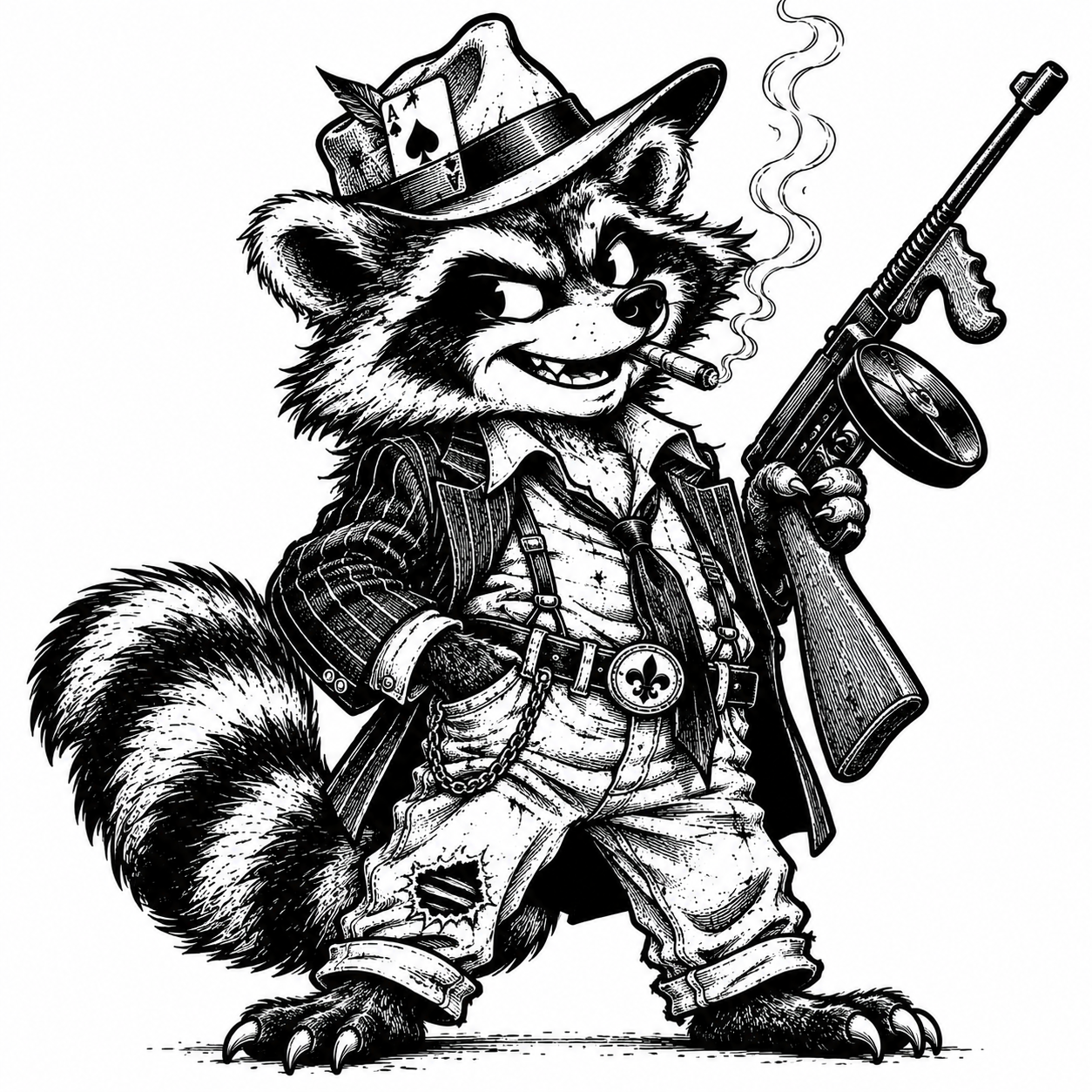
The first time I met Clyde, he was standing on the counter of a convenience store holding a Tommy gun, and Elbert Dale Hoss was explaining to him that two people could not legally CON FETTY the same establishment without a prior agreement.
I had known Elbert my entire life.
I had seen him mistake a funeral for a church-sponsored supper. I had seen him conduct agricultural experiments that made me question whether the Department of Agriculture ought to be carrying firearms. I had personally prevented him from mailing a live chicken to a man who had asked for a letter of recommendation.
But until that afternoon, I had never watched him negotiate territorial rights with an armed raccoon.
And I certainly hadn’t expected the disagreement to end in chowder.
It started with a telephone call.
Not from Elbert, naturally. Elbert doesn’t believe a telephone call is necessarily meant for the person who answers it. He figures if somebody calls a house, they must have business with the house.
The call came from a woman named Darlene who worked at a convenience store out on the parish road.
“Miss Betsy,” she said, “you know Elbert Hoss?”
I closed my bookkeeping ledger.
“What’d he do?”
“Well, he’s in here with a raccoon.”
“That ain’t a crime by itself.”
“The raccoon’s got a machine gun.”
I looked at the clock.
It wasn’t even two in the afternoon.
“Is anybody hurt?”
“Not yet.”
“Keep everybody away from the gun. I’m coming.”
I hung up, grabbed my keys, and drove out there thinking about all the reasonable things a person might do with a Tuesday afternoon.
Elbert had apparently exhausted the list.
Darlene’s store was a perfectly ordinary little place. Two gas pumps, a sun-faded sign, a refrigerator full of drinks, and a coffee machine that had probably violated the health code before I was born.
The front door was propped open.
Darlene stood behind the counter looking like she’d aged four years since calling me.
A raccoon stood beside the register with a Tommy gun almost as long as he was.
And Elbert stood in the snack aisle holding a grocery sack.
“Elbert.”
He turned around.
“Hey, Bets.”
“Why is there a raccoon with a gun?”
“That’s Clyde.”
“I didn’t ask his name.”
“He’s got a name, though.”
The raccoon made a short, irritated noise.
Elbert nodded at him.
“See?”
I looked at the gun.
Then I looked at Darlene.
“Has he fired that thing?”
“Not in here,” she said.
I did not like the qualification.
“Elbert, what are you doing?”
“CON FETTY.”
He said it like a man answering a question about his occupation.
I looked inside his grocery sack.
There were several packets of colored paper, a roll of tape, and what appeared to be a handful of loose feathers.
“Where’d you get all that?”
“Acquired it.”
“From where?”
He pointed toward a shelf.
I took a breath.
“Elbert, you cannot walk into somebody else’s business, take things off the shelf, and start decorating.”
“Ain’t decoratin’.”
“What is it, then?”
“CON FETTY.”
He looked at me like the distinction ought to have settled everything.
Darlene leaned forward.
“He’s been here forty minutes.”
“What happened?”
“He came in first. Said he was claiming the place. Then that raccoon came through the door and started hollering.”
Clyde thumped the butt of his gun against the counter.
Darlene flinched.
Elbert pointed at him.
“That’s what I been tellin’ him. He can’t just show up and CON FETTY on top of another man’s CON FETTY.”
I folded my arms.
“And why not?”
“Overlap.”
“Overlap?”
“Can’t have two operations runnin’ together. Gets confusing.”
“Confusing to who?”
He considered that.
“Everybody.”
It was a difficult answer to dispute, considering the circumstances.
I asked Darlene whether she’d called the sheriff.
“Not yet. I figured I’d call you first.”
That was the sort of judgment people in Katy Bill had developed after years of living near Elbert Dale Hoss.
Sometimes the sheriff was necessary.
Sometimes I could get there first.
And sometimes I arrived in time to discover we needed the sheriff, the fire department, and a licensed veterinarian.
I stepped toward Clyde.
He watched me with a level of suspicion I usually associated with men who had something to hide from the Internal Revenue Service.
“Clyde,” I said, “put the gun down.”
He did not.
“Elbert, tell your friend to put the gun down.”
“He ain’t my friend.”
“Then tell the raccoon you’re arguing with.”
Elbert looked at Clyde.
“Bets says set your gun down.”
Clyde stared at him.
Elbert stared back.
Neither moved.
“Well?” I asked.
“He’s thinkin’ on it.”
Clyde adjusted his grip.
I was beginning to suspect the raccoon wasn’t doing much thinking at all.
Darlene spoke from behind me.
“He wants the store to himself.”
“How do you know?”
“He keeps pointing at Elbert and pointing at the door.”
Elbert shook his head.
“That’s his interpretation. I was here first.”
“Then leave,” I said.
“Can’t.”
“Why?”
“Unfinished gig.”
“Who’s paying you?”
“Nobody yet.”
I closed my eyes.
That was another thing about Elbert. He could turn an unpaid criminal undertaking into a matter of professional integrity faster than any man alive.
I told Darlene to take the customers out the back and wait somewhere safe. She did, and I was relieved to see her go.
Now I only had to manage Elbert and the raccoon.
Which, as it turned out, was more than enough.
The dispute might have ended peacefully if Elbert hadn’t decided that the proper solution was lunch.
“I reckon we need to settle this over chowder,” he announced.
I stared at him.
“Why?”
“Men settle things over food.”
“Clyde is a raccoon.”
“He eats.”
That was true.
It did not make the plan better.
Elbert said he knew how to make chowder because Daddy had shown him how to prepare a pot of stew when he was young.
I believed that part.
Daddy Hoss had taught Elbert a great many useful things. How to measure, how to maintain equipment, how to plant a crop, how to keep a fire under a pot without scorching everything inside it.
The trouble was that Daddy had never managed to teach him which situations required those skills.
Elbert walked toward the rear of the store.
“Where are you going?” I asked.
“Gettin’ supplies.”
“From where?”
“Truck.”
He’d parked his old farm truck out front. At that time, he was still driving it himself.
I followed him outside because I had learned long ago that the phrase gettin’ supplies could mean almost anything.
He climbed into the back and came out with a battered cooking pot, a small propane burner, and a chainsaw.
I looked at the chainsaw.
“Elbert.”
“What?”
“Why do you have that?”
“Cut stuff.”
“What stuff?”
“Chowder stuff.”
I considered driving away.
Not because I didn’t care about him.
Because I cared about myself.
I should explain something about Elbert’s cooking.
He isn’t incapable of following a recipe.
Quite the opposite.
He can measure ingredients. He understands heat. He knows when a pot needs stirring. If Daddy showed him how to do something, he may remember the procedure better than a professional cook.
What he cannot reliably determine is whether the thing he’s cooking belongs in a pot.
I had once watched him spend twenty minutes carefully seasoning a handful of spark plugs.
He had been very particular about the salt.
So when Elbert carried that chainsaw toward the store, I knew we were entering dangerous territory.
“Put that down.”
“Need it.”
“For what?”
“Chowder.”
“Elbert, a chainsaw is not a kitchen utensil.”
“It cuts.”
“So does a knife.”
“Not as fast.”
I couldn’t argue with that without accidentally encouraging him.
Clyde appeared in the doorway, still holding the gun.
He watched Elbert unload the cooking equipment.
Then he lowered the barrel slightly.
That was the first encouraging thing I’d seen all afternoon.
It was also the last.
Elbert set the burner on the gravel beside the building.
I made him move it farther from the gas pumps.
He measured the distance himself, using a tape measure from his truck, and moved it exactly as far as I instructed.
See what I mean?
Competent procedure.
Insane premise.
He filled the pot with water from the store’s outside faucet.
Then he went back inside and came out carrying two cans of vegetables, a sack of potatoes, a package of crackers, and several little cubes of Boo Leon.
I paid Darlene for all of it.
“What’s the chainsaw for?” she whispered.
“I am working on that.”
Elbert arranged the ingredients beside the pot.
Then he opened a plastic storage tub from the truck.
Inside were several pieces of scrap wood, a rusty length of chain, and something I sincerely hoped had once belonged to a lawn mower.
“Elbert.”
“Yeah?”
“What is that?”
“Crime.”
I stared at him.
“Crime?”
“Crime parts.”
“What the hell are crime parts?”
“Things from crimes.”
“Which crimes?”
He shrugged.
“Different ones.”
I had no intention of investigating that answer in front of witnesses.
He picked up the rusty chain.
“Gonna cut these down.”
“For what?”
“Chowder.”
I grabbed his wrist.
“No.”
He looked surprised.
“Why?”
“Because you are not putting rusty metal in food.”
“Ain’t food yet.”
“It isn’t going to become food!”
He considered this for a moment.
Then he said, “Well, I’ll wash it.”
There are moments in a woman’s life when she realizes language has failed her.
This was one of mine.
I confiscated the chain and the other metal pieces.
Elbert complained that I was interfering with his recipe.
I told him his recipe could go straight to hell.
Clyde, meanwhile, had climbed onto the tailgate and was examining the chainsaw.
“Don’t touch that,” I told him.
He touched it.
“Elbert, get the saw away from him.”
Elbert took it back.
Clyde made an angry noise.
Elbert nodded.
“See, Bets? He understands equipment.”
“He’s holding a machine gun.”
“That’s equipment.”
I turned toward the sky.
It was a clear, beautiful afternoon.
Birds were singing.
Somewhere, decent people were living decent lives.
And I was standing behind a convenience store preventing a raccoon from operating a chainsaw.
Elbert eventually agreed to make the chowder without the metal.
Not because he’d accepted my argument.
He simply decided the crime parts could be served separately.
I put them in the truck where he couldn’t reach them.
He chopped the potatoes properly, measured the water, added the vegetables, and crumbled in the Boo Leon.
Then he reached for the chainsaw.
“No.”
“Need to chop.”
“You already chopped everything.”
“Fine chop.”
“You have a knife.”
“Chainsaw’s quicker.”
“Elbert, if you put that chainsaw anywhere near this pot, I swear—”
He pulled the starter cord.
The engine roared.
Darlene screamed from inside the store.
Clyde sprang backward off the tailgate.
I stepped away before Elbert could swing the damned thing toward me.
He wasn’t trying to threaten anybody.
That was the problem.
He was trying to cook.
He lowered the running saw toward a pile of vegetable scraps on a wooden board.
The chain caught the edge.
The board jumped.
Potato peels flew everywhere.
One struck Clyde directly between the eyes.
The raccoon made a noise I had never heard from any animal and sincerely hope never to hear again.
Then he raised the Tommy gun.
“CLYDE!” I shouted.
Elbert looked up.
“What?”
“TURN THAT THING OFF!”
He shut down the chainsaw.
Clyde stood perfectly still, a potato peel hanging from his forehead.
For one terrible second, nobody moved.
Then Clyde shook his head.
The peel fell off.
And he began making a sound.
At first I thought he was growling.
Then I realized he was laughing.
Or at least doing something close enough that I wasn’t interested in correcting the terminology.
He slapped the tailgate with one paw.
Elbert grinned.
“See? Fine chop.”
I looked at the wrecked cutting board.
Then at the vegetables scattered across the gravel.
Then at the raccoon who had apparently found the entire incident delightful.
I wanted a drink.
A large one.
The chowder itself was surprisingly edible.
Once I had removed the chainsaw from the proceedings, Elbert finished the pot using ordinary cooking methods.
He simmered it carefully.
He stirred it.
He tasted it.
He added another Boo Leon cube.
He even waited until the potatoes were tender.
The man could cook.
That fact had never once made me feel safer around him.
When it was finished, he ladled a serving into a bowl and set it on the tailgate.
Clyde approached.
He sniffed it.
He tasted it.
He ate the whole thing.
Then he looked at Elbert.
Elbert looked back.
“Well?”
Clyde made a low chattering sound.
Elbert nodded solemnly.
“Reckon that’s settled.”
“What is settled?” I demanded.
“Territory.”
“Which territory?”
“CON FETTY territory.”
“And what exactly did y’all agree to?”
Elbert scratched his chin.
“He can have that store.”
I stared at him.
“You were here first.”
“Yep.”
“You spent half the afternoon arguing over it.”
“Yep.”
“And now you’re giving it to him?”
“Yep.”
“Why?”
He looked at Clyde.
Then at the empty bowl.
Then back at me.
“Chowder.”
I waited for more.
There wasn’t any.
Clyde climbed onto the passenger seat of the truck.
Elbert climbed behind the wheel.
I stood there trying to understand what agreement had just been reached.
Clyde leaned across the seat and slapped the horn.
Elbert laughed.
“C’mon, Bets. He’s ready.”
“Ready for what?”
“Ride.”
I looked at the raccoon.
The raccoon looked at me.
He still had the Tommy gun.
“Elbert, you are not taking an armed raccoon home.”
“Why not?”
“Because he’s armed!”
“He was armed when we met.”
I had no response to that which wouldn’t require explaining the entire concept of civilization.
Darlene came outside after they left.
She surveyed the potato peels, the ruined cutting board, the scorched patch of gravel, and the mess beside the store.
“Miss Betsy,” she said, “what was all that?”
I opened my purse.
“How much do I owe you?”
She named a figure.
I paid it.
Then I paid extra for the trouble.
Darlene looked toward the road.
“That raccoon coming back?”
“I sincerely hope not.”
“What about Elbert?”
I thought about that.
“Elbert’ll be back somewhere,” I said. “I just don’t know where yet.”
By the following morning, Clyde had appeared at the Hoss farm.
According to Elbert, the raccoon had shown up before breakfast and taken an interest in Daddy’s old Turnip Wagon Truck.
I drove over after receiving a telephone call that consisted mostly of Elbert telling me he needed to discuss “professional transportation.”
When I arrived, Clyde was sitting behind the steering wheel.
The truck wasn’t moving.
Thank God.
Elbert stood beside the driver’s door explaining the arrangement.
“Clyde’s gonna drive.”
“Drive what?”
“Truck.”
“Elbert, that’s a raccoon.”
“Coon Show Fur.”
“What?”
“Coon Show Fur. He drives. I ride.”
I looked at Clyde.
Clyde looked at me.
He had both paws on the wheel.
I had the distinct impression he was waiting for me to get out of his way.
“Elbert, does he even know how to drive?”
“Reckon we’ll find out.”
“No, we will not.”
I took the keys.
Clyde made an irritated noise.
Elbert frowned.
“Bets, you’re holdin’ up the gig.”
“There is no gig.”
“Not yet.”
I looked at that raccoon.
Then I looked at Elbert Dale Hoss.
And for reasons I still cannot adequately explain, I had the feeling my life had just become considerably more complicated.
People around Katy Bill eventually started calling the convenience-store affair Chainsaw Crime Chowder.
I never found out who coined the name.
Elbert claimed it was a proper recipe.
Darlene insisted it was a criminal incident.
Clyde apparently regarded it as the beginning of a professional relationship.
I considered it an afternoon I would have gladly paid to forget.
But I will tell you one thing.
Before that day, Elbert Dale Hoss was a problem I could usually locate by the sound of his own truck.
After that day, I had to start watching for a raccoon behind the wheel.
And somehow, that made everything worse.