Tale #002 — The Great Katy Bill Possum Scandal
As told by Betsy LeAnne Broussard
The trouble started with a flyer at Frank’s Farm & Feed.
Now, I know what you’re thinkin’. How much trouble can one little flyer cause?
In most towns, not much.
But this was Katy Bill, Loosyaner, and the man readin’ that flyer was Elbert Dale Hoss.
The flyer said the Katy Bill Agricultural Fair was holdin’ its annual livestock competition. There’d be judges, ribbons, trophies, and a cash prize for Best in Show.
Elbert read that last part twice.
Then he went home and told Paul he was fixin’ to make him a champion.
Paul, bein’ a possum, didn’t have much to say about it.
By Thursday afternoon, I was standin’ behind the counter at Betsy’s Stop-N-Go when my telephone rang.
“Betsy’s Stop-N-Go. This is Betsy.”
“Miss Broussard?” a woman asked. “This is Mrs. Bernice Thibodeaux with the agricultural fair committee.”
I knew Bernice. She was a sensible woman who’d run the fair’s livestock division for fourteen years without a single cow gettin’ loose.
That record was about to end.
“Afternoon, Bernice.”
“I’m callin’ about an application we received from Mr. Elbert Dale Hoss.”
I closed my eyes.
“What’s he done?”
“He has entered an animal named Paul in the small-livestock competition.”
“Lord.”
“Under species, he’s written possums.”
“That’s Paul, all right.”
“Under sex, he’s written male.”
“Elbert thinks Paul’s a boy.”
“Is he?”
“No, ma’am.”
There was a long silence.
“Miss Broussard, why would a grown man enter a female possum as a male farm animal?”
“Bernice, if I knew how Elbert Dale’s mind worked, I’d charge admission.”
She cleared her throat.
“He’s listed you as the animal’s business representative.”
“He did what?”
“And under occupation, he’s written agricultural maintenance and security.”
I put my forehead against the cooler door.
“Bernice, don’t approve nothin’. I’ll handle it.”
“I already rejected the application.”
“Good.”
“Mr. Hoss says he intends to appeal.”
“Of course he does.”
“He says Paul has seniority.”
I hung up.
There are days when I think I ought to sell both businesses, buy myself a little house somewhere with no telephone, and live out the rest of my life in peace.
Then I remember Elbert Dale would probably find me and ask whether the ocean needed bushhoggin’.
I found him at the farm, sittin’ on an overturned bucket beside the shed where he and Paul lived.
He had a pencil behind his ear, Daddy’s old farm ledger across his knees, and Paul asleep in a nest of towels.
“Elbert.”
“Hey, Betsy.”
“Why’d you enter Paul in the fair?”
He looked surprised.
“Well, he’s livestock.”
“No, he ain’t.”
“He’s alive.”
“That don’t make him livestock.”
“He lives on a farm.”
“So do you.”
“Yeah, but I ain’t enterin’ myself.”
I had to give him that one.
“Elbert, possums ain’t eligible for livestock judging.”
“How come?”
“Because the competition’s for farm animals.”
“Paul’s a farm animal.”
“He’s a wild possum.”
“Not wild. He’s got a room.”
I looked toward the shed.
Paul was flat on his back with all four feet pointed toward heaven, so thoroughly stoned and comfortable that a brass band could’ve marched through there without interruptin’ his afternoon.
“Elbert, what exactly does Paul do on this farm?”
He opened Daddy’s ledger.
“Security.”
“Security?”
“Keeps my safe keys.”
“That’s not a job, Elbert. That’s you losin’ your keys in a possum.”
“Never lost ’em yet.”
He turned a page.
“Also agricultural maintenance.”
“Explain that.”
“Eats bugs.”
“Every possum eats bugs.”
“Well, then, he’s got experience.”
I sat down on the other bucket.
“Elbert, you’re not takin’ Paul to that fair.”
“Already told him he was goin’.”
“He don’t understand you.”
“Well, he didn’t object.”
I looked at Paul.
Paul snored.
Friday morning, I got to the fairgrounds a little after ten.
The place was already crowded. Kids were hollerin’ around the game booths, old men were inspectin’ tractors they had no intention of buyin’, and the smell of fried catfish and barbecue was driftin’ across the livestock pens.
I spotted Daddy Hoss’s old wooden-sided Turnip Wagon Truck parked beside the exhibition barn.
Clyde was behind the wheel, wearin’ his fedora.
His Tommy gun was laid across the seat.
I walked up to the window.
“Clyde. That gun stays in the truck.”
He stared at me.
“Don’t look at me like that. No Con Fetty, neither.”
Clyde slowly reached over and pushed a small sack beneath the seat with one paw.
I decided not to ask.
Elbert was standin’ beside a wooden crate lined with towels.
Inside was Paul, asleep.
“Elbert, why’s he in a crate?”
“Presentation.”
“He’s unconscious.”
“Restin’ up for competition.”
I glanced down at the clipboard in his hand.
“What’s that?”
“Paul’s work history.”
He’d written it on three pages torn from Daddy’s ledger.
The first line said:
PAUL HOSS — SIX YEARS EXPERIENCE — NO COMPLAINTS.
“Elbert, you cannot put a possum’s employment record before a livestock committee.”
“Why not?”
“Because he’s a possum!”
“Well, they oughta know that before they hire him.”
Before I could answer, Bernice Thibodeaux came marchin’ out of the exhibition barn with two other committee members.
She was wearin’ a blue blouse, sensible shoes, and the expression of a woman who’d already had enough of this particular Friday.
“Mr. Hoss,” she said, “I explained this over the telephone. Your animal is not eligible.”
Elbert nodded.
“That’s why I’m here to appeal.”
“There’s nothing to appeal.”
“Y’all ain’t looked at his qualifications.”
“Mr. Hoss, we judge livestock according to established categories.”
“Paul’s established.”
“Possums are not an approved category.”
“Well, put him in with the little ones.”
“Mr. Hoss—”
“He’s little.”
Bernice took off her glasses.
I knew that look. It was the look a woman gets when she’s decidin’ whether jail might be quieter than her present circumstances.
“Elbert,” I said, “put Paul back in the truck.”
“But Betsy, they ain’t even seen him work.”
“HE DOESN’T WORK.”
Elbert frowned.
“Well, he ain’t gonna with everybody hollerin’ at him.”
And before anybody could stop him, he opened the crate.
Paul blinked once.
Then the smell of fried food hit her little possum nose.
She climbed out, dropped to the ground, and waddled straight toward the concession stands.
“Paul!” Elbert called. “Come show these people your agricultural maintenance!”
Paul kept walkin’.
“See?” Elbert told Bernice. “Independent worker.”
Now, the livestock barn and the food concessions were separated by a line of portable metal gates. The gates were there to keep animals out of the food and people out of the animals.
It was a sound arrangement.
It would’ve remained a sound arrangement if Elbert Dale Hoss hadn’t been born.
Paul slipped beneath a barbecue stand and disappeared among the crates of supplies.
The woman workin’ the stand spotted her.
“THERE’S A POSSUM UNDER MY TABLE!”
Elbert waved.
“That’s Paul!”
“GET HIM OUT!”
“He’s inspectin’!”
“HE’S EATIN’ MY CORNBREAD!”
“Well, that’s how he inspects!”
The woman grabbed a broom.
Paul, havin’ no interest in being swept, crawled out the back of the stand and headed toward the livestock pens.
Elbert followed.
He came to the metal gate, found it latched, and unhooked it.
I saw him do it.
“ELBERT! PUT THAT BACK!”
“Can’t, Betsy! Paul’s on the clock!”
A livestock handler came runnin’.
“Sir, that gate needs to stay closed!”
“Just passin’ through.”
“You can’t leave it open!”
“I ain’t leavin’ it. I’m right here.”
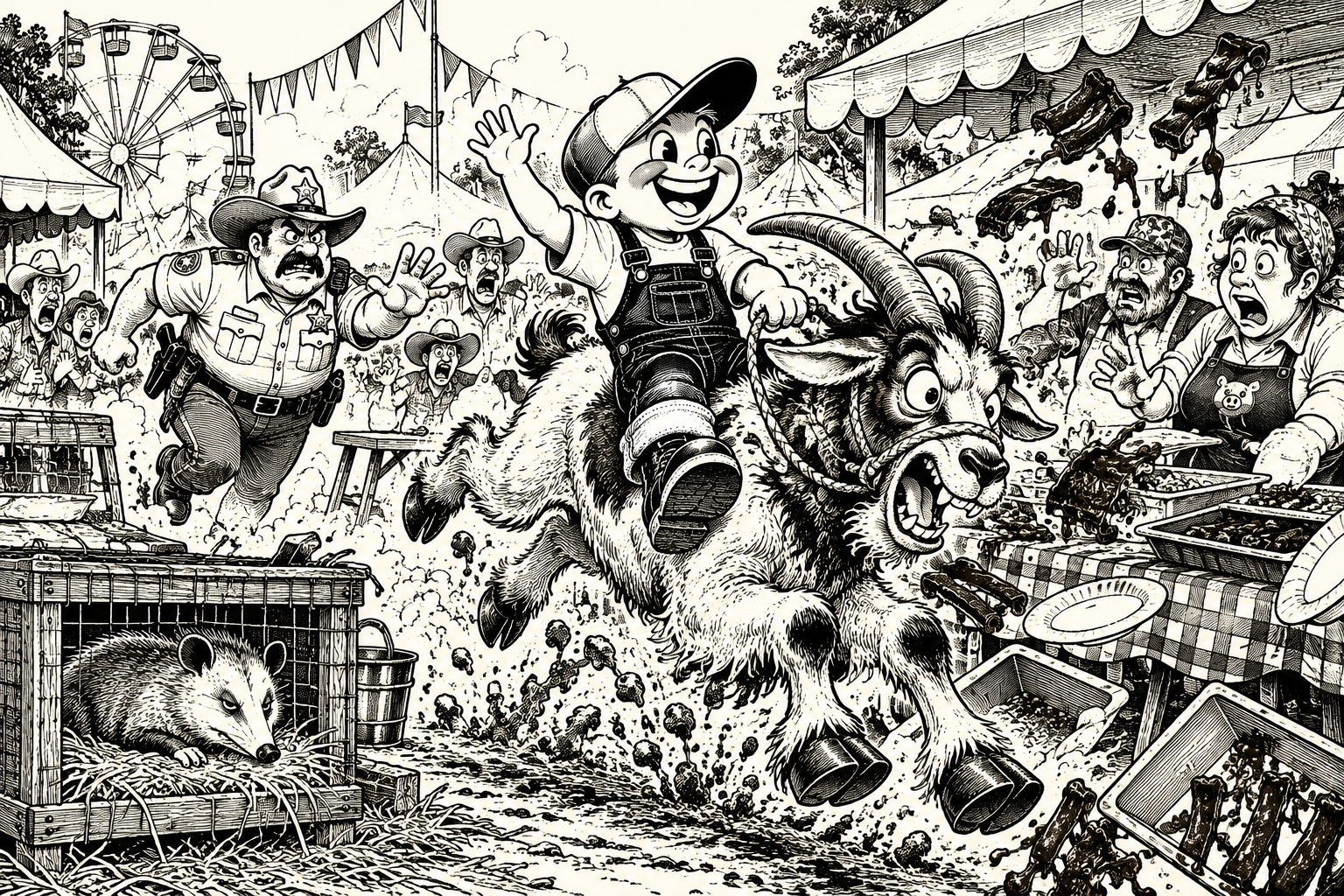
And while those two argued over what leavin’ meant, a prizewinning Boer goat named Colonel Biscuit saw his opportunity.
Colonel Biscuit was a magnificent animal.
White body, brown head, heavy shoulders, and a set of horns that looked like somebody had designed ’em specifically for arguments.
He’d won three ribbons that morning and was due to be presented with the fair’s Grand Champion trophy.
He also wanted out of that pen.
The goat shoved through the open gate.
His handler hollered.
“THE GOAT’S GETTIN’ LOOSE!”
Elbert turned.
Now, Daddy Hoss had taught that boy how to handle farm animals. He’d taught him how to saddle a horse, mend a fence, back a trailer, and get a stubborn mule headed in the right direction.
Unfortunately, Elbert had never developed a reliable method for distinguishin’ one situation from another.
He saw a loose animal.
He saw nobody ridin’ it.
And he made the worst decision in the recorded history of the Katy Bill Agricultural Fair.
He jumped on the goat.
Not beside it.
Not in front of it.
On it.
Both arms around its neck, both legs hangin’ down, boots draggin’ in the dirt.
Colonel Biscuit froze for half a second.
I reckon he was considerin’ his options.
Then he took off like Satan himself had slapped him on the ass.
“ELBERT DALE HOSS!”
“OPEN THE GATE, BETSY!”
“GET OFF THAT GOAT!”
“CAN’T! HE’S STILL LOOSE!”
Colonel Biscuit charged through the exhibition lane with Elbert floppin’ on his back like a sack of feed tied to a runaway wheelbarrow.
A judge dropped his clipboard.
Two children started cheerin’.
Somebody yelled, “IS THAT PART OF THE SHOW?”
“No!” Bernice screamed. “IT IS NOT!”
The goat cut hard around the poultry tent.
Elbert leaned the wrong way.
They missed a display of prize pumpkins by about three inches, clipped a folding chair, and headed straight for the food concessions.
I ran after ’em.
I don’t know why.
There wasn’t a blessed thing I could’ve done except witness the consequences.
A woman was crossin’ the midway with two overloaded plates of barbecue, baked beans, potato salad, and coleslaw.
Colonel Biscuit saw her.
Colonel Biscuit dodged.
Elbert did not.
Both plates hit him square in the chest.
Barbecue sauce went up his neck.
Potato salad landed in his hair.
Baked beans filled the front of his overalls.
And that damn goat kept runnin’.
I have seen Elbert Dale Hoss do some spectacularly stupid shit in thirty-five years. But until that Friday afternoon, I’d never seen a grown man ride a prizewinning goat through a county fair with enough baked beans in his lap to feed the First Baptist congregation.
And the son of a bitch was still hollerin’ for somebody to open the gate.
Colonel Biscuit made one final turn beside the championship display.
His shoulder struck the corner of the trophy table.
The table folded.
Ribbons flew.
Three trophies hit the ground.
One rolled beneath a parked tractor.
The goat bucked.
Elbert went airborne.
He landed flat on his back in a heap of spilled coleslaw beside the barbecue stand.
For one beautiful second, everything went quiet.
Then Elbert sat up.
He looked at the beans on his overalls.
He looked at the potato salad slidin’ off his shoulder.
And he said, loud enough for the whole fairground to hear:
“I LOVE RIDIN’ TROPHY GOATS IN GRUB!”
I thought Bernice Thibodeaux was gonna have a stroke.
The goat’s handler caught Colonel Biscuit near the livestock wash station.
The goat was fine.
Mad as hell, but fine.
Paul was discovered twenty minutes later beneath the cornbread stand, curled up inside an empty cardboard box.
She’d eaten enough to make herself comfortable and had apparently decided the fair was an excellent place for a nap.
Elbert carried her back to the Turnip Wagon.
He was still covered in barbecue.
Bernice met us at the truck with a clipboard.
“Mr. Hoss, your animal is disqualified.”
Elbert frowned.
“Paul didn’t ride no goat.”
“That is not the point.”
“He didn’t knock over them trophies, neither.”
“Mr. Hoss, you knocked over the trophies.”
“Well, I was tryin’ to keep the goat from gettin’ loose.”
“YOU WERE RIDING IT!”
“That’s how I was keepin’ up with him.”
Bernice pressed her lips together so hard they nearly disappeared.
“Possums are not eligible for livestock judging. That decision is final.”
She handed him a paper.
“And you’ll be responsible for the damage to the championship display.”
Elbert looked at the paper, then handed it to me.
“What’s it say, Betsy?”
“It says you owe the fair eleven hundred dollars.”
“For what?”
“The trophies, the table, the fencing, and the concession stand.”
He considered that.
“Well, reckon Colonel Biscuit oughta pay half.”
“Elbert.”
“He was drivin’.”
I paid the deposit on the damages before Bernice could decide to involve Biggun.
Then I told Clyde to get Elbert and Paul home.
Clyde looked at Elbert’s bean-covered overalls, looked at the truck’s clean passenger seat, and made a noise that sounded an awful lot like a complaint.
“Don’t start,” I told him. “You can clean the seat.”
He put the truck in gear.
As they pulled away, Elbert leaned out the window.
“Betsy!”
“What?”
“Reckon they’ll have a goat-ridin’ division next year?”
“GO HOME, ELBERT!”
I thought that was the end of it.
I should’ve known better.
Saturday morning, Frank called me from the feed store.
“Betsy, you know what size bushhog Elbert’s got?”
I was pourin’ my first cup of coffee.
“Why?”
“Well, he’s down here wantin’ a replacement blade, two grease fittings, and a manufacturer’s identification plate.”
“For what?”
Frank hesitated.
“Says he’s convertin’ Paul.”
I put down the coffee.
“Frank, don’t sell him a goddamn thing.”
“Already told him he can’t just call a possum a bushhog. Told him he’d need proper implementation.”
I closed my eyes.
“Oh, Frank.”
“What?”
“You have no idea what you’ve done.”
I hung up and drove straight to the farm.
Found Elbert kneelin’ beside Paul’s shed with Daddy’s measuring tape, a pencil behind his ear, and a notebook full of numbers.
Paul was sprawled in her towels, higher than a giraffe’s asshole and completely uninterested in the business of agricultural machinery.
“Elbert, what the hell are you doin’?”
“Measurin’ Paul for a bushhog.”
“A BUSHHOG?”
“Well, they won’t let him compete as livestock, Betsy. Reckon I’ll enter him in the farm equipment division.”
“ELBERT, PAUL AIN’T GOT NO BLADES!”
He looked at me like I was the dumbest woman in Washitall Parish.
“Well, hell, Betsy. That’s why I went to Frank’s.”
I looked down at the notebook.
He’d written down Paul’s length, width, tail length, and what he called workin’ clearance.
“Why are you takin’ all these measurements?”
He looked up, pleased with himself.
“I LOVE MEASURIN’ POSSUMS FOR IMP LA MINT TATE SHUNS.”
“Elbert, do you even know what implementation means?”
“Course I do.”
“Then tell me.”
“Means I gotta measure him before I can implement him.”
Paul rolled over in her towels and went right back to sleep.
I went home.